
A CRM that agrees with your ERP.
PRISM CRM is our CRM for industrial and B2B suppliers. Accounts with many sites, a pipeline worked deal by deal, quotations and purchase orders read straight from the ERP, and forward revenue set against budget. Each client gets their own deployment, under their own name, on their own servers.
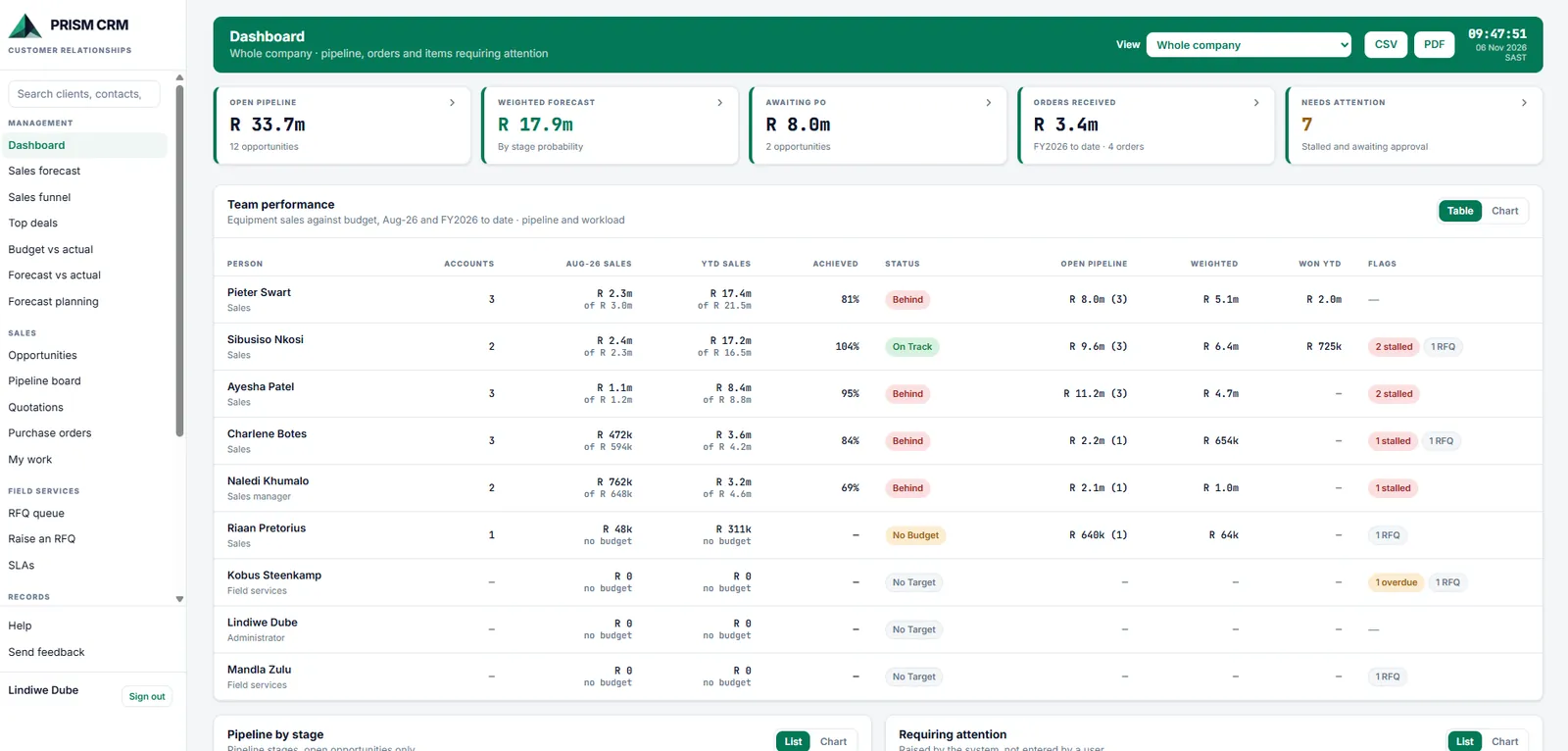
The pipeline lives in one system. The numbers live in another.
A supplier's ERP holds the quotations, the purchase orders and the invoices. The sales team's view of the pipeline lives somewhere else, usually a spreadsheet or a generic CRM that knows nothing about either. Every month-end someone stitches the two together by hand, and the forecast that reaches the board is only as good as that stitching.
The usual errors are quiet ones. Open quotes get folded into the forecast and the same revenue is counted twice. Sales with no budget line drop out of the report. One customer code covers six plants, and nobody can say which plant the deal is for.
Sales, management and field service on one set of numbers.
Pipeline & deals
Stages and probabilities the client sets for themselves. Each deal carries a strategy sheet in the Miller Heiman tradition: buying influences, red flags, competition, action plan. Deals move on real events. Issuing a quotation advances one, a purchase order closes it as won, and a stalled deal raises its own chase task.
Forecast & budget
Invoiced actuals from the ERP, the weighted pipeline as the forward view, and open quotes shown beside it rather than folded in. Budget against actual by area, manager, branch, customer and sale type, with every screen exporting to CSV and a board-ready PDF.
RFQs, SLAs & sites
Sites are first-class records, with their contacts and installed equipment. A companion field app captures quote requests, interactions and site photos in front of the customer, and they land in the queue the office works from. Service agreements sit in a register that flags what is about to expire.
From the board's forecast down to the deal that moved it.
Screens show the demonstration tenant, a fictional supplier. Every name and figure is invented.
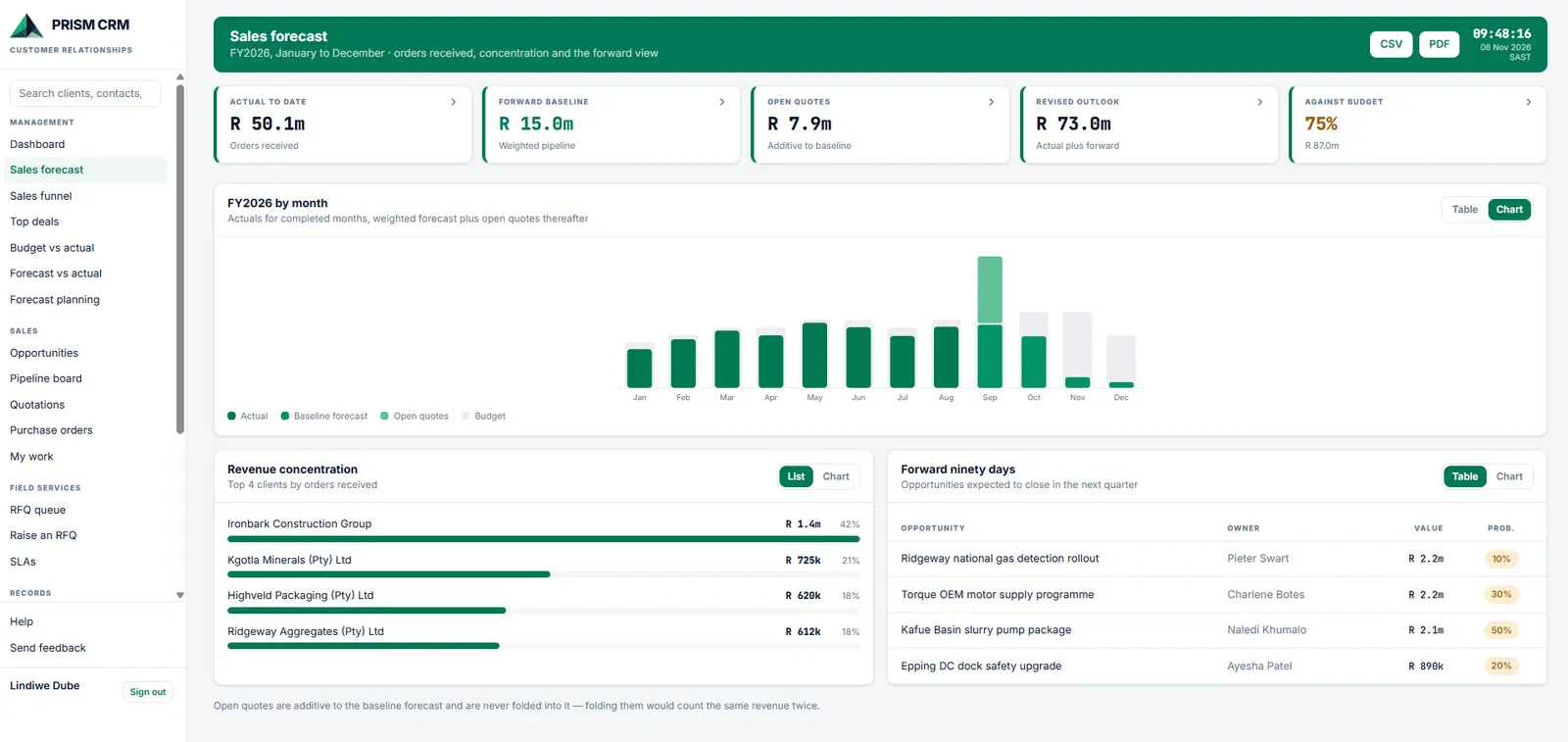
Sales forecast
Actuals for the months that have closed, weighted pipeline and open quotes for the months that have not, all against the budget line. Open quotes are kept additive to the baseline and never folded into it, so the outlook cannot count the same rand twice. Below it: how concentrated the revenue is, and what is due to close in the next ninety days.
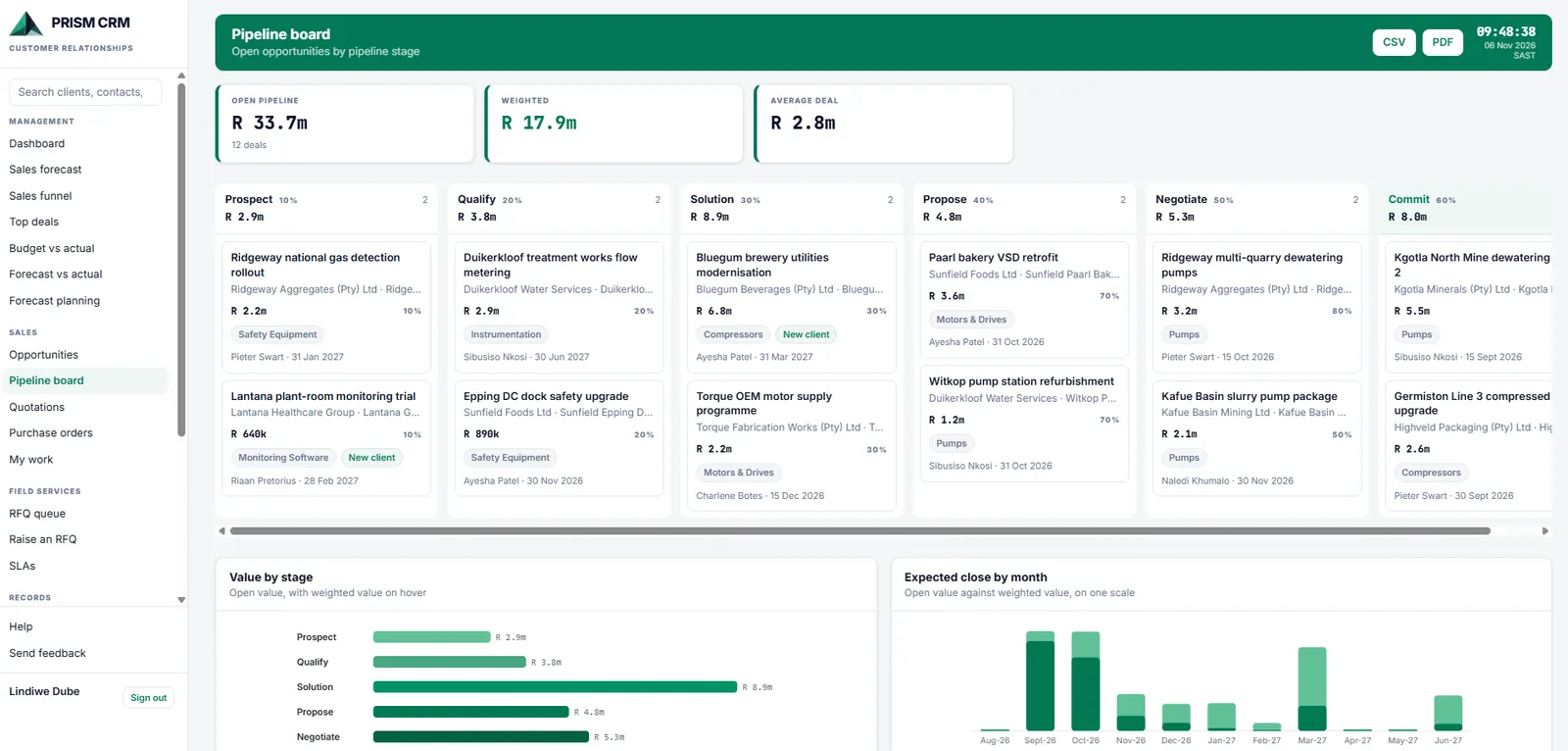
Pipeline board
Every open deal in its stage, with the value, the product class, the owner and the expected close date on the card. Each column totals itself. Underneath, open and weighted value are drawn on one scale, by stage and by expected month, so a heavy quarter is visible before it arrives.
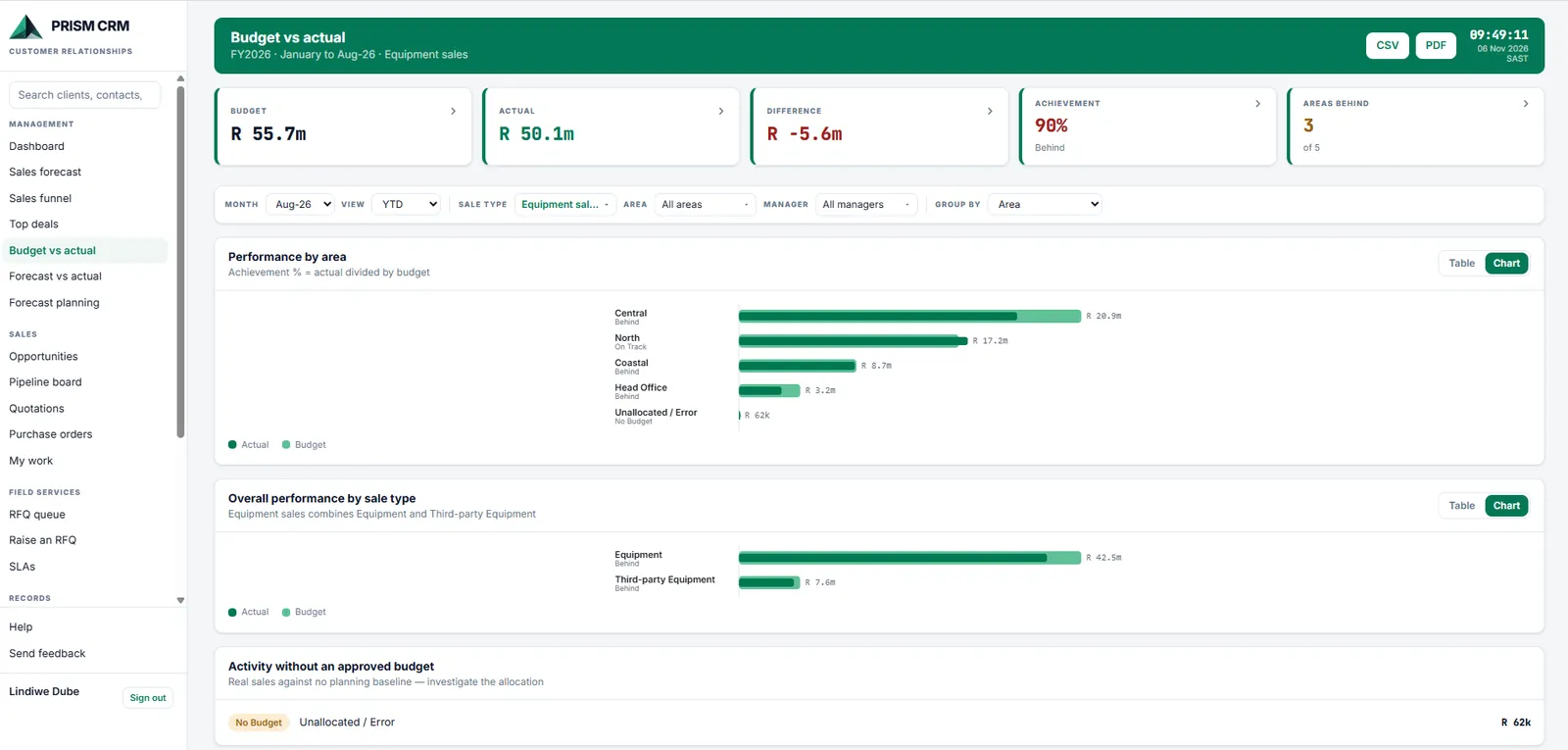
Budget vs actual
Achievement by area and by sale type, month or year to date, filtered by a link you can send to someone else. Sales that have no approved budget are reported as “No Budget” rather than dropped, so unallocated revenue stays on the page until somebody deals with it.
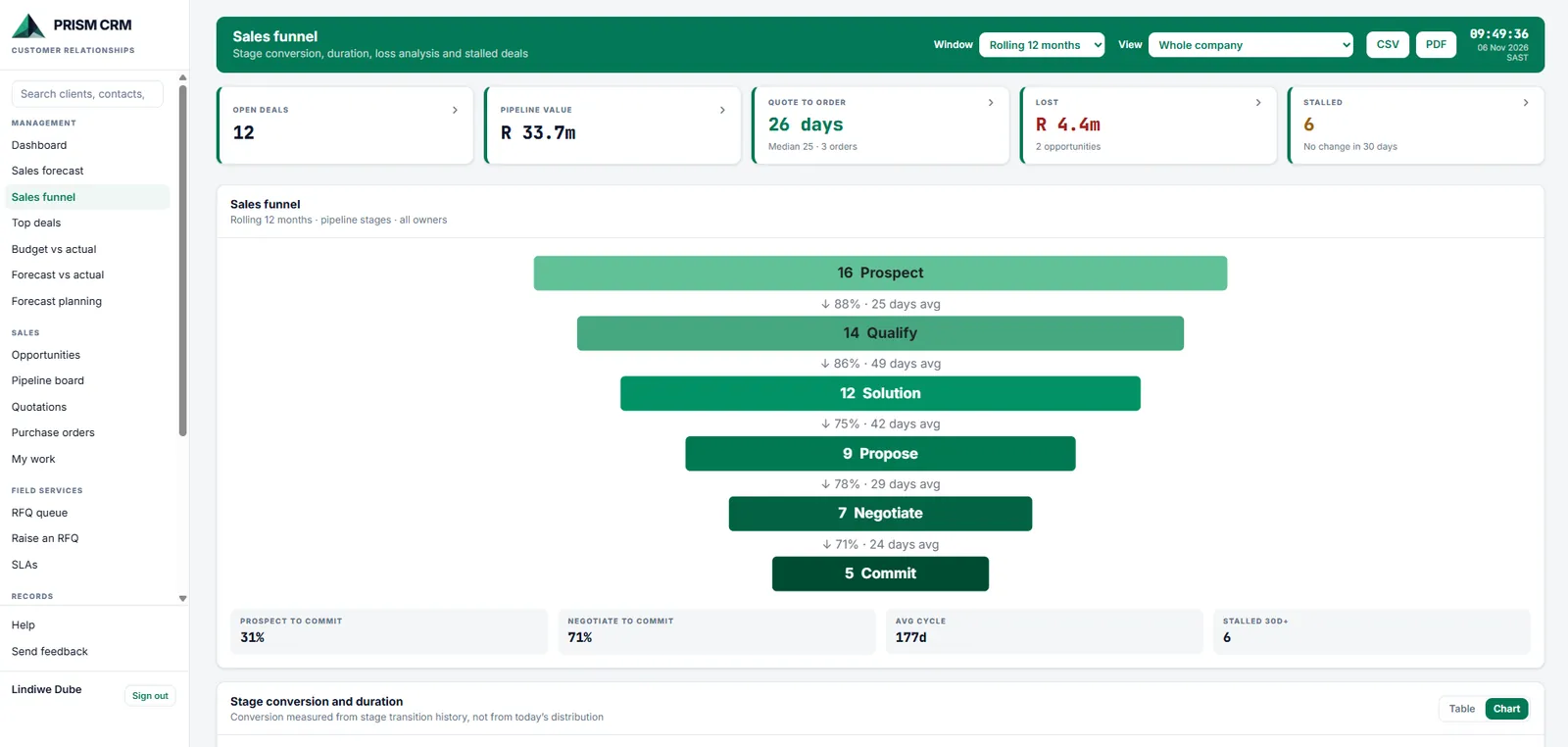
Sales funnel
Conversion is measured from the history of stage moves, not from where deals happen to sit today, which would leave out everything already won or lost. Each step shows how many deals got through and how long they took, next to quote-to-order time, the value lost and the deals that have not moved in thirty days.
Your name on the door
Each deployment is set up through a single configuration: the product name and colours, currency and time zone, the month the financial year starts, the pipeline stages, and the words the business uses for its areas, sale types and product classes. Nothing about one client is written into the code.
Built to sit beside the ERP, not to replace it.
The ERP stays the system of record. PRISM CRM reads customers, invoices, quotations, orders and the price book from it on a read-only login, and keeps what the sales team captures safe across every refresh. It ships as one container that the client's own IT team runs, with no subscription service behind it and no per-user licence.
Ready to demo on invented data. A deployment starts with a read-only look at your ERP, so you know the state of your customer data before anyone signs in.
Ask for a demo