
It works. Is it safe?
AI app builders do what you ask. The trouble is what you didn’t know to ask, like who else can read your customers’ records.
The numbers
Veracode, a security company, tested code written by AI models against the most common web vulnerabilities. In its August 2025 report, 45% of the samples failed. An update in March 2026 found the pass rate hadn’t improved, still at about 55%.
Researchers went further in 2026, auditing 200 apps that had been built mostly by AI and were already live. Of those, 91% had at least one vulnerability, and about two-thirds of the problems they found were rated critical or high.
It has already happened
In May 2025, a flaw in apps built with the Lovable app builder was published as CVE-2025-48757 and rated 9.3 out of 10 for severity. Many of the apps’ databases could be read by anyone, because a setting called row-level security, which decides who can see which records, had never been switched on.
In July 2025, the Tea dating-safety app exposed users’ photos, including ID documents, from cloud storage that had been left open. A second leak followed days later.
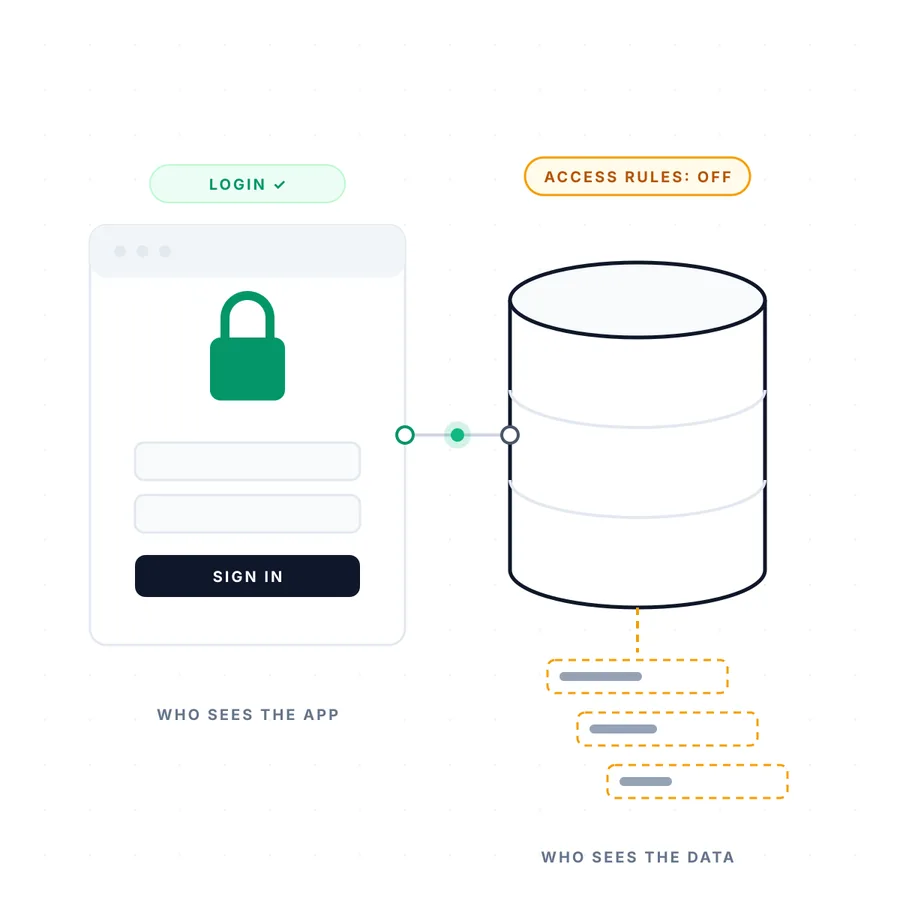
The login screen isn’t the lock
A login page decides who gets into the app. Rules in the database decide who sees the data. A demo only needs the first. A real system needs both, and the second is invisible until someone goes looking.
The cause is knowledge, not the tool
The same 2026 study looked at why the holes were there. About 63% came from knowledge gaps: the builder didn’t know a protection was needed. About 55% were security requirements nobody had stated, so they were never built. And in roughly one run in five, the AI agent noticed the risk and shipped the code anyway.
The tool builds what you describe. If nobody describes access control, there isn’t any.
The tool builds what you ask for. The risk is in what you didn’t know to ask.
How we build instead
- Who can see what is designed together with the data model, not added after a demo.
- Passwords, keys and secrets stay on the server, never in the browser.
- Every release is tested and reviewed by a senior developer before it goes live.
- At the end we run it for you under support, or hand over the repository, tests and documentation.
Your customers’ data is the part they’ll never see. That’s why it has to be right.
- Cloud Security Alliance, research notes on AI-generated code vulnerabilities, 4 and 6 April 2026 (citing Veracode’s 2025 GenAI Code Security Report and March 2026 update, CVE-2025-48757 and the Tea app breach). https://labs.cloudsecurityalliance.org/research/csa-research-note-ai-generated-code-vulnerability-surge-2026/ and https://labs.cloudsecurityalliance.org/research/csa-research-note-ai-codegen-vulnerability-debt-20260406-csa/
- Deng, Fan and Meng, Understanding the (In)Security of Vibe-Coded Applications, arXiv preprint, 2026 (not yet peer reviewed). https://arxiv.org/html/2606.23130v4
You run the business. We’ll answer for the system.